Wednesday, February 29, 2012

Italian Engineer invents floating solar panels

So you think that Solar PV would deprive you from building a house on your piece of land, or leaving you with no space for planting crops. Not necessarily.

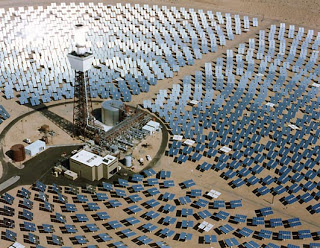
Floating PV panels on the surface of  lake in  Colignola. Image: Daily Express, 28.2.2012

A creative engineer in Italy have recently come up with a cost-effective prototype of PV floating plant which tracts the sun and became a model of efficiency. 


Key benefits
 
1. Saving precious agricultural land
2. Less intrusive. Solves the ugly sight of traditional  installation in fields
3. Resolves panel overheating issues
4. Significantly cheaper than ground-based structure 


Specifications

Location: small lake of Colignola, Pisa, Tuscany Italy
Capacity: 30kW
Design: Floating Tracking Cooling Concentrator (FTCC)
Cooling method: lake water
Supply: 10 to 12 families (3kW per apartment)
Estimated cost: €1,600 per kW (RM6,500) including installation 
Colignola small-scale design would cost €48,000 (RM195,000)
Compared with ground-based system: Cheaper by some 20%
Note: 30kW capacity did not specifically mentioned kWp (kilowatt peak) but my bet is that it is 30kWp based on the installation size and the accompanying photo.

Interesting fact:

Sicily has about 75 km2 of artificial reservoirs and lakes. If 10% or 7.5km2 of that area is covered with floating PV panels, engineers believe that there would be 1 GW of power installed. 

To put things into perspective, Sabah's current energy maximum demand is slightly more than 700 MW. Think about harnessing solar energy from Sicily and power up Sabah with 300MW access capacity. This is no doubt suitable for lakes, reservoirs or abandoned quarries. Former Mamut copper mining in Ranau comes into mind.


The full Article by PVsolar-uk here:

Engineers in Italy have created a cost effective prototype for floating and rotating solar panels on the lake of Colignola. The engineers have also incorporated mirrors into the mix to harness the power of the sun more efficiently.
Marco Rosa-Clot, a professor at Florence University, has proudly announced they are revolutionising solar power and the flower-petal-like objects have already attracted alot of attention from international buyers.
These panels are said to resolve some of the issues your average panels on buildings or in fields are faced with. More conventional panels have been penalised for taking up valuable argricultural land, looking unsightly and losing energy through overheating.
The water keeps the panels cool, while the reflectors are positioned to utilise maximum power of the sun.
Engineer Raniero Cazzaniga has metioned that some people believe your more traditional installation is spoiling the landscape. He comments; "Our system is designed for low-lying quarries. The installation is only about a metre (three feet) high and usually you can't see it until you get to the water's edge. It is not at all intrusive," he said.
Rosa-Clot believes their project will allow a greater number of installations at a much more affordable price.

Sabah Population in 2010?


Is there any truth to these figures? Anyone care to interpret this statistics?

Monday, February 27, 2012

How to Copyright "Kopitiam"

Ever wondered how to copyright kopitiam so that no one else would ever use it except you? Easy. Go and file your suit in Indonesia.

Image credit: shahalam.com

Ok, that was sweeping. But at least others won't be using the term in any business venture there. The Chinese word kopitiam is kedai kopi in Malay or coffee shop as what we would understand it all the world over.

So, if you can copyright kopitiam then there's no stopping you from asking people to stop using 'bread' as in iBread, Nasi Kandar, or 'cloud' as in iCloud. I will name my coffee shop Kota Kinabalu Nasi Kandar and claimed intellectual property rights over that very words.

I remember when cloud computing was making its way into the IT world, IT giant Apple was said to buy iCloud domain from a Sweden company for $4.5mil, although the company declined to confirm the accuracy of the price.

I am now thinking about patenting 'anything' and call it iAnything so that the next time I see you using that word I could file a suit for $4.5mil. Of course you can do anything to you like with it, continue using it and I would not be able to anything to get anything from it.

If you are in Malaysia and Singapore though, try copyrighting Kedai Kopi instead, as patenting kopitiam does not work there. If you are in New York, try visiting Malaysia Kopitiam there.

For the info-hungry, here is the original report of the enlightening event:


Indonesian restaurateur wins "kopitiam" copyright
The star Online. Feb 27, 2012

JAKARTA: The Indonesian courts have ruled in favour of a local restaurateur who claimed intellectual property rights over the word "kopitiam" - a Chinese word which means coffee shop.

The Jakarta Post ran a story today that in 2010, Abdul Alek Soelystio, the owner of Jakarta-based "Kopitiam", had sued "Kok Tong Kopitiam" in the Medan Administrative Court for using the word and won the case.

Abdul claimed he had registered intellectual property rights to "kopitiam" in 1996. Unhappy with the outcome, "Kok Tong Kopitiam" owner Paimin Halim appealed to the Supreme Court, but the lower court's decision was merely upheld.The report said, Abdul took out an advertisement in a national newspaper on Feb 6 this year warning other restaurateurs to immediately drop "kopitiam" from their brand identities.

Abdul's lawyers said that whoever used kopitiam could be charged with piracy.

The Intellectual Property Law provides for up to seven years' imprisonment for those convicted of intellectual piracy, although in practice violators are seldom sentenced to more than several months.Indonesia Kopitiam Association chairman Mulyadi Praminta described the rulings in favour of Abdul as ridiculous.

"There was a similar case in Singapore. A company tried to copyright kopitiam as its own, but the government there rejected the request. It is shocking that we have a contradictory situation here," he remarked.Mulyadi felt that the government should support the restaurant industry instead of providing special treatment to certain parties.

"The local industry deserves support from the government. We hire many people, we use local products, including coffee beans," he added.

Meanwhile Bondan Winarno, Indonesia's most famous gastronome and owner of the "Kopitiam Oey" chain, asserted over the weekend that no one should be allowed to copyright the word.

Bondan, the association's spokesman, asserted that kopitiam offered a local option that could rival international coffee shops in Indonesia. "Kopitiam is not our creation. The name does not belong to us, but to generations before us. It is not a brand but a signature of culinary culture as well as social assimilation," he emphasised. BERNAMA

Sunday, February 26, 2012

Mugabe to Cameron: To Hell With You

While not agreeing him words for words, I agree with his idea. Malaysia, like many African nations, should reject outright any such provision. Enough said.

mugabe800
Daily Express - Feb. 27, 2012


Zimbabwean President Robert Mugabe said his government entirely rejected the suggestion from its former colonial master. He said: We reject that outright and say to hell with you.

Addressing the UK leader, who said last year that countries receiving British aid should respect human rights, including gay rights, he said: "You David Cameron, are you suggesting that you don't know that or is it some kind of insanity or part of the culture of Europeans.

Flywheels

If you ever work in wood processing mill you’d be familiar with band-saws. The saws are attached to two big flywheels driven by AC motors. The wheels don’t need high initial torque to start rotating but once spinning, the band saw is capable of tearing apart even the biggest and hardest log.

Image: chinasawmills.com


Or, if you own a small diesel generator set – typically 5kVA to 10kVA – you’d be familiar with the tiring starting method. You need to spin a small but heavy flywheel to get the diesel engine going.

These are example of age old applications of flywheel. Let’s look at how flywheel is still relevant in today’s advance engineering. The following is an article I read from Daily Express:

What is a Flywheel?

A flywheel is a wheel that’s spun at high speed and used to store energy. They’ve been used for years in everything from traction engines to toy cars. But now Jaguar and Volvo want to see if they can be used to drive up fuel efficiency.

How would that work?

The car’s wheels would spin the flywheel, which would continue to spin until the stored energy was needed to drive the car. The stored energy would then be transferred back to the wheels via a transmission.

Are they currently used in cars?

Flywheels are an alternative to the Kinetic Energy Recovery System (KERS) most Formula 1 teams have been using last year. But although they’re permitted by the sport, no team currently uses them and neither are they found in road cars. F1 designers have worked on improving the technology but developing a flywheel is a headache; a great deal of stored energy can be lost to friction.

So what has changed?

F1 engineers have reduced the weight of flywheels using composite materials and cut friction by sealing the wheels inside a vacuum chamber. But it’s hard to make the seals between flywheel and transmission perfect. In F1, the seals only need to last for a short period of time. In road cars they need to be far more durable.

Is there a solution?

Engineering firm Ricardo has built a magnet-based system in which there’s no direct contact between flywheel and transmission. Jaguar is working with Ricardo and others on a flywheel, and Volvo is also looking into the technology for use in its vehicles.

Hope this will work towards energy efficient vehicles in the near future.

Source: Daily Express, Sunday Feb. 26, 2012